StrongLifts 5×5: credit and sources
Created by Mehdi Hadim.
Primary source: Stronglifts 5×5 Workout Program: Quick Start Guide (stronglifts.com)
Mehdi Hadim says he did not invent the 5×5 approach. StrongLifts' own history page traces it through Reg Park (1958), Bill Starr (1976) and Glenn Pendlay (early 2000s); Mehdi published his A/B version in June 2007.
This guide summarizes and comments on the original program. Credit belongs to the original author(s). Strength Progression is independent and not affiliated with or endorsed by them; for the complete program, use the original source.
StrongLifts 5×5 is Mehdi Hadim's beginner barbell program: two alternating full-body workouts, three days a week, five lifts, and a simple rule for adding weight. This guide summarizes the official StrongLifts pages and labels our commentary. For the program itself, use the official site and app.
Where 5×5 comes from
Mehdi is upfront that he didn't create the 5×5 idea. The StrongLifts history page traces it to Reg Park's 1958 book, Bill Starr's 1976 "Big Three" program for football players, and Glenn Pendlay's online version in the early 2000s. Mehdi's June 2007 guide was based on Pendlay's, with an A/B schedule, empty-bar starts for new lifters, optional arm and ab work, and the deadlift cut to one set of 5.
Program summary
Who it is for
- New lifters who want a simple, structured plan built on the squat, bench press, overhead press, barbell row and deadlift.
- People who can train three days a week with a rest day between sessions.
- Lifters who like an app or spreadsheet to do the arithmetic.
Who it is not for
- Lifters who have already run a linear progression to a stall and worked through the deload rule.
- People who want lots of exercise variety or bodybuilding volume from day one.
- Anyone with an injury or medical condition that hasn't been cleared for heavy barbell training. Get qualified medical input first.
How the program works
The two workouts
| Workout | Lift 1 | Lift 2 | Lift 3 |
|---|---|---|---|
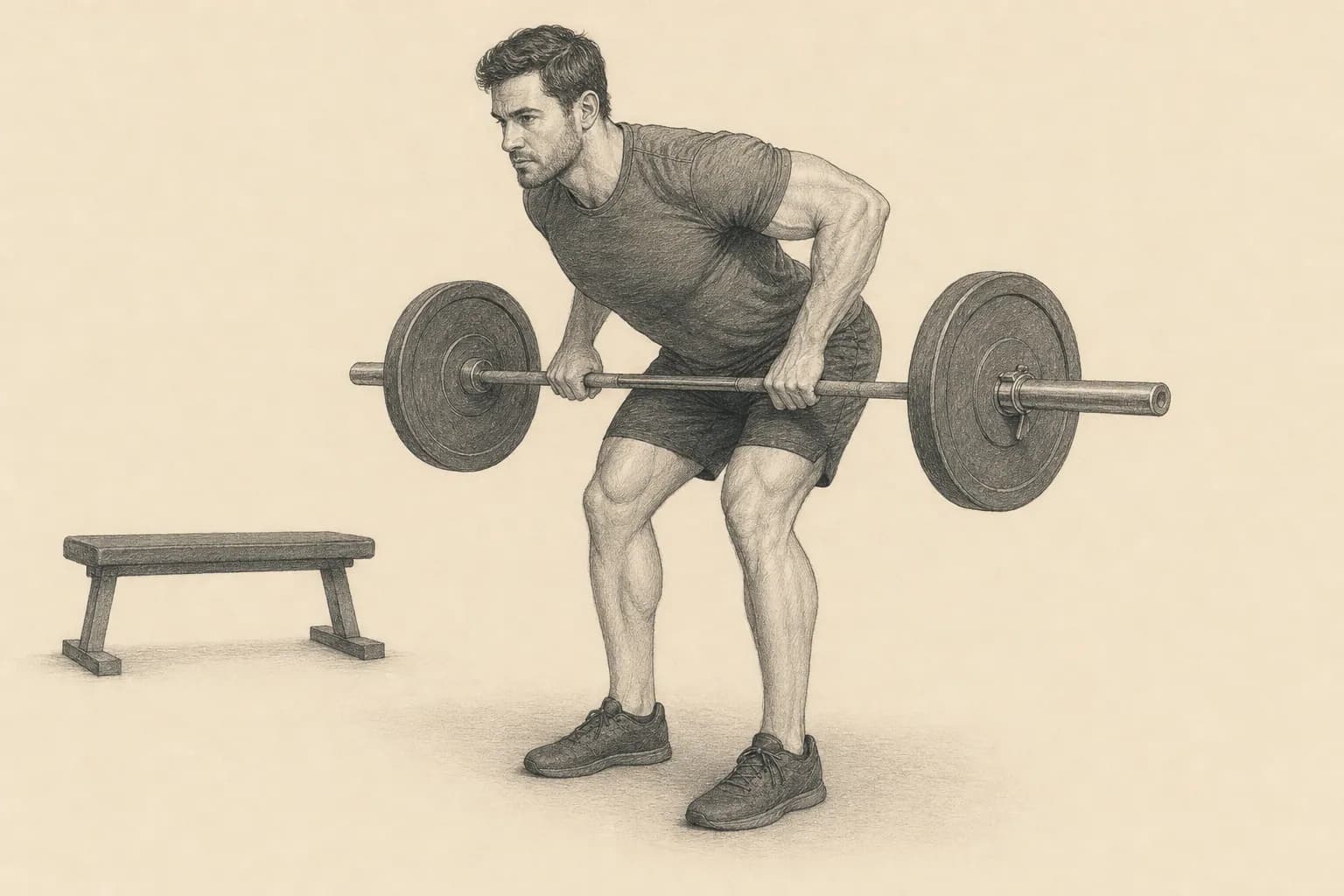
| A | Squat 5×5 | Bench press 5×5 | Barbell row 5×5 |
| B | Squat 5×5 | Overhead press 5×5 | Deadlift 1×5 |
"5×5" means 5 sets of 5 reps. You alternate A and B three times a week, with at least one rest day between sessions. On a Monday, Wednesday, Friday schedule the pattern rolls over:
| Week | Mon | Wed | Fri |
|---|---|---|---|
| 1 | A | B | A |
| 2 | B | A | B |
| 3 | A | B | A |
Why the deadlift is 1×5
Cutting the deadlift to one set of 5 was one of Mehdi's changes to Pendlay's version. Our reading of why it makes sense: you've already squatted 5×5 that session, the deadlift is the heaviest lift in the program, and one hard set keeps it progressing without burying your recovery for the next squat day.
Starting weights
The Quick Start guide tells new lifters to start with the empty bar (45 lb / 20 kg) on the squat, bench press and overhead press, and lighter-than-you-think weights on the deadlift (95 lb / 40 kg) and barbell row (65 lb / 30 kg). Lifters with some experience can instead pick a weight they could lift for about 10 reps and use it for 5×5. If your first workout is a struggle, the guide says you started too heavy.
Warm-up sets vs work sets
The five sets of five are your work sets: the ones you log and progress. Warm-up sets come before them and don't count toward the 5×5. The Quick Start describes starting with two sets of 5 on the empty bar, then doing progressively heavier sets until you reach the work weight, with little rest between warm-ups. On the deadlift and row, you start warm-ups heavier and take bigger jumps. The app's warm-up calculator gives exact weights.
Example (ours). Squat work sets at 155 lb (70 kg): empty bar 2×5, 95 lb (40 kg) ×5, 125 lb (55 kg) ×5, then 5×5 at 155 lb. Use the plate calculator to load each jump, and see warm-up sets for squat, bench and deadlift for the general method.
Rest between sets
The Quick Start suggests about 3 minutes between work sets: shorter (1–2 minutes) after easy sets, around 3 minutes after normal sets, and up to 5 minutes after sets where you struggled to get all 5 reps.
How much weight to add
- Default: add 5 lb (2.5 kg) to a lift each time you complete all its sets and reps.
- Squat and deadlift: 5–10 lb (2.5–5 kg). The guide advises against 10 lb jumps on the squat; men can add 10 lb to the deadlift for the first few weeks, then switch to 5 lb.
- Bench press, overhead press and row: 2.5–5 lb (1.25–2.5 kg). The progress page says women tend to do better with 2.5 lb jumps on the bench and overhead press.
- Later: when adding weight every workout gets hard, use smaller plates or add weight every two or three workouts instead.
If your gym only has 5 lb plates, your smallest jump is 10 lb; small or fractional plates make the upper-body lifts much easier to progress.
What to do when you fail
- If you don't complete 5×5 with good form on a lift, repeat that weight next time. Only the lift you failed repeats; the others keep progressing.
- Doing more total reps than last time at the same weight counts as progress.
- If you still fail, try one more workout at the same weight.
- After three failed workouts at the same weight, deload by about 10% and work back up.
- The failure page also suggests resting longer between sets and switching to smaller jumps (2.5 lb or less) once you've started failing reps.
You may see advice elsewhere to drop to 3×5 after a stall. The current StrongLifts failure page doesn't include that step.
Example decision log (ours, for illustration only)
An overhead press on Workout B:
| Workout | Weight | Reps | Decision |
|---|---|---|---|
| 1 | 95 lb (42.5 kg) | 5, 5, 5, 5, 5 | Completed. Add 5 lb |
| 2 | 100 lb (45 kg) | 5, 5, 5, 4, 3 | First failure. Repeat 100 lb, rest longer |
| 3 | 100 lb | 5, 5, 5, 5, 4 | Second failure, but more reps. Try once more |
| 4 | 100 lb | 5, 5, 5, 4, 4 | Third failure. Deload about 10% to 90 lb (40 kg) |
| 5 | 90 lb | 5 × 5 | Build back up, now in 2.5 lb jumps |
Use the official app and spreadsheet
StrongLifts publishes a free app and spreadsheets that calculate starting weights, warm-ups and rest. Use those rather than copies on other sites: stronglifts.com/stronglifts-5x5.
Reasons to choose a different program
Consider something else if:
- You want power cleans and a coach-led approach. Starting Strength, by Mark Rippetoe, uses 3 sets of 5 and includes power cleans.
- You want more volume and AMRAP sets. GZCLP, by Cody Lefever, is another novice linear progression with a tiered structure.
- You prefer a conservative training max and built-in conditioning. See 5/3/1 for Beginners, Jim Wendler's three-day template.
- You want to train more often with bodybuilding work. See the Reddit linear progression PPL in our push/pull/legs guide.
How StrongLifts and Starting Strength differ on paper:
| StrongLifts 5×5 | Starting Strength | |
|---|---|---|
| Creator | Mehdi Hadim | Mark Rippetoe |
| Work sets on most lifts | 5 sets of 5 | 3 sets of 5 |
| Deadlift | 1×5 on Workout B | 1×5, later alternating with power cleans |
| Other pulling work | Barbell row 5×5 on Workout A | Power clean 5×3 from Phase 2; chin-ups in Phase 3 |
| Stall rule | Repeat; deload about 10% after three failed workouts | Repeat once; deload 8–10% after a second miss |
These are structural differences from the official pages, not evidence that one produces better results.
Common mistakes
- Starting too heavy. Light early sessions give you time to practice technique before the weights get serious.
- Counting warm-ups as work sets. Warm-ups prepare you; the 5×5 is what you progress.
- Deadlifting 5×5. The program's deadlift is one set of 5.
- Deloading after one bad day. The rule is three failed workouts at a weight, then deload.
- Taking 10 lb jumps on everything. Small plates keep the upper-body lifts moving much longer.
- Rushing rest. Take the longer rests the guide recommends after hard sets.
For more on loading, see how to add weight to the bar and technique priorities for squat, bench and deadlift.
Pillars Check
Workout
Three sessions a week, A/B alternating, every work set logged. Follow the failure rule exactly rather than improvising. More in the Workout pillar.
Diet
Adding weight three times a week takes enough food to recover. An International Society of Sports Nutrition position stand puts protein intakes of 1.4–2.0 g per kg of body weight per day as sufficient for most people who train (Jäger et al., 2017). Track your body weight; if it's falling and your lifts are stalling, eat more. More in the Diet pillar and protein for lifters.
Recovery
Sleep 7 or more hours a night, the adult minimum in the sleep medicine consensus (Watson et al., 2015), and keep the rest days between sessions. Before you deload a lift, check whether short sleep or a stressful week explains the misses. More in the Recovery pillar and recovery 101.
When to move on
The StrongLifts pages don't set a fixed length, and neither do we. Our criteria, built on the official failure rule:
- Early stalls: repeat, deload about 10% after three failed workouts, and switch to smaller jumps or adding weight every two or three workouts, as the progress page suggests.
- Repeated stalls: if you've deloaded a lift more than once and keep stalling at about the same weight, with sleep and food in order, linear progression on that lift is likely done.
- Most lifts there: move to a program with planned weekly or monthly progression.
StrongLifts' own site lists follow-on options, such as its SL5×5 Intermediate program. On this site, options include 5/3/1, PHUL and the upper/lower split. For the bigger picture, read when you're not a novice anymore and linear progression explained.
FAQ
Who created StrongLifts 5×5?
Mehdi Hadim, who launched StrongLifts in 2007. He says he didn't invent the 5×5 approach; his version builds on Glenn Pendlay's, which in turn follows earlier 5×5 programs by Bill Starr and Reg Park.
Is the deadlift 5×5 in StrongLifts?
No. The deadlift is 1 set of 5 on Workout B. Every other lift is 5 sets of 5.
What weight should I start with?
The Quick Start tells new lifters to start with the empty bar on the squat, bench and overhead press, and light weights on the deadlift and row. If you have experience, use a weight you could lift for about 10 reps.
How long should I run StrongLifts?
There's no fixed length. Run it while you can keep adding weight, apply the failure and deload rule when you stall, and move on once repeated deloads stop getting you past the same weights.
What happens if I fail a set?
Repeat the weight next time for that lift only. After three failed workouts at the same weight, deload by about 10% and work back up.
Sources
- Hadim M. "Stronglifts 5×5 Workout Program: Quick Start Guide." stronglifts.com. stronglifts.com. Supports the A/B workouts, schedule, starting weights, warm-ups, rest and increments.
- Hadim M. "How to Progress on Stronglifts 5×5." stronglifts.com. stronglifts.com. Supports the default 5 lb (2.5 kg) jump, smaller jumps, and adding weight every two or three workouts.
- Hadim M. "How to Overcome Failure on Stronglifts 5×5." stronglifts.com. stronglifts.com. Supports the repeat-and-deload rule.
- Hadim M. "History of the 5×5 workout." stronglifts.com. stronglifts.com. Supports the Reg Park, Bill Starr and Pendlay lineage and Mehdi's 2007 changes.
- "About Stronglifts." stronglifts.com. stronglifts.com/about. Supports the 2007 launch and Mehdi's statement that he didn't invent 5×5.
- "Stronglifts 5×5: The Complete Workout Guide." stronglifts.com. stronglifts.com. Official program hub, app and spreadsheets.
- Jäger R, et al. "International Society of Sports Nutrition Position Stand: protein and exercise." J Int Soc Sports Nutr. 2017;14:20. doi:10.1186/s12970-017-0177-8. Supports the protein range.
- Watson et al. "Recommended Amount of Sleep for a Healthy Adult: A Joint Consensus Statement of the American Academy of Sleep Medicine and Sleep Research Society." SLEEP. 2015;38(6):843–844. doi:10.5665/sleep.4716. Supports the sleep minimum.