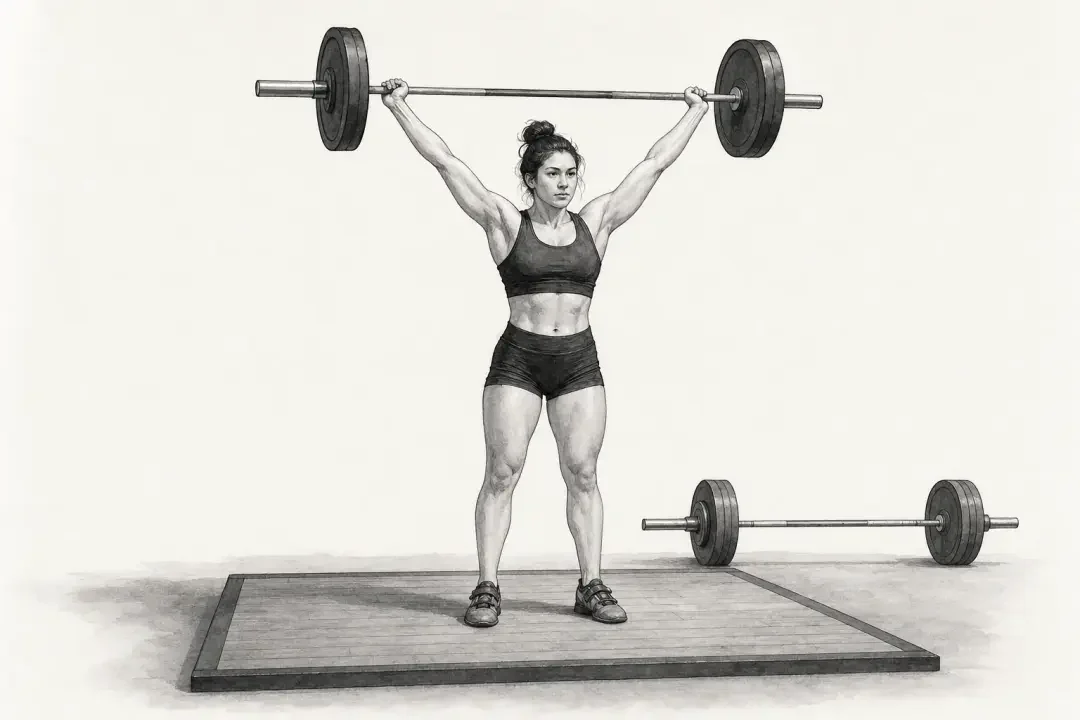
Searching for a "beginner Olympic weightlifting program" usually turns up a spreadsheet of snatches and clean & jerks at fixed percentages. For someone still learning the lifts, that is often the wrong tool.
There are two different jobs here. First you learn the movements, with a qualified coach. Then you start training them in planned cycles. This guide helps you work out which job you're doing, what a program assumes about you, and how to judge one before you commit to it.
TL;DR
- Learning the lifts and training the lifts are different phases. Many published programs, including the Catalyst starter block discussed below, assume you can already perform the lifts.
- In the learning phase, your coach's teaching plan is the program, and loads are chosen by how well your positions hold.
- Percentage-only plans need a recent, technically sound max in the classic lifts. Most novices don't have one yet.
- Pick a frequency you can sustain. More days only help if you arrive fresh enough to practice well.
- Plan your feedback. In our view a qualified coach, in person where possible, is the most reliable way to learn the lifts; video is a useful supplement.
- Use the checklist below to evaluate any program, including free ones like Catalyst Athletics' Starter Program.
What to do this week
- Decide which phase you're in using the table below. If you're unsure, ask your coach.
- Write down your real schedule: days per week, session length and equipment.
- Run any candidate program through the evaluation checklist.
- Set up feedback: ideally a qualified coach, in person if you can, plus regular video of your heavier sets.
- If you haven't learned the lifts yet, read Olympic weightlifting for beginners first.
First, which phase are you in?
| Learning phase | Training cycles | |
|---|---|---|
| Main goal | Learn positions and link them into the snatch and clean & jerk | Get better at the lifts you can already perform |
| Who decides the load | Your coach, set by set, based on positions | The program's rules: feel, percentages of a tested max, or both |
| Typical work | Drills, hang and block variations, light classic lifts, basic strength work | Classic lifts and variations, pulls, squats, planned heavier days |
| How progress shows | The same positions at slightly heavier loads | Heavier lifts and totals over weeks and months |
| What "program" means | A coach's teaching plan | A written cycle, such as a starter block or a coach's program |
These readiness signs are coaching guidance, not a formal test. You are probably ready for written training cycles when:
- You can perform both lifts from the floor with repeatable positions at light and moderate loads.
- Your coach agrees your technique holds when you add weight.
- You can tell a technical miss from a strength miss, at least most of the time.
- You recover from three or more sessions a week.
If you can't say yes to the first two, you are still in the learning phase. A written cycle won't fix that; coached practice will.
Prerequisites a program quietly assumes
Most programs don't list their assumptions. Check these before you start:
- Competent technique in the snatch, clean and jerk, and in the variations the program uses, such as power, hang and block versions.
- A reliable max if loads are percentages: recent, tested in the classic lifts, and made with sound positions.
- Equipment: bumper plates, space to drop the bar, and sometimes blocks or jerk boxes.
- Time: the number of days, and the session length, the program was written for.
- Feedback: someone who can see your lifts and adjust the plan.
Frequency: how many days
| Days per week | When it fits | Watch for |
|---|---|---|
| 2 | Very busy schedules, or weightlifting alongside another sport | Slow technical progress; long gaps between practice |
| 3 | Our suggested starting point for adults in the learning phase | Make each session count; lift practice first |
| 4 | Competent lifters with time to recover | Squat and pull volume stacking up |
| 5 or more | Experienced lifters, or short introductory blocks written for it | Fatigue eroding technique; life stress |
Research on general resistance training suggests frequency matters for strength partly because it adds volume. A 2018 meta-analysis found the effect disappeared when volume was equated, while a 2026 meta-regression still found identifiable frequency effects on strength. These studies didn't test the Olympic lifts. For skill work, the practical rule is to choose the highest frequency you can attend consistently and still arrive fresh. That's coaching guidance, not a research finding.
Why percentage-only plans are unreliable for novices
A percentage is only as good as the max it's taken from. A novice's max snatch or clean & jerk is unstable: it can jump as technique improves, or reflect one lucky lift.
Worked example. A plan prescribes snatches at 75% of your best. Your logged best is 50 kg (110 lb), so 75% is 37.5 kg (83 lb). Here's how that same prescription lands depending on what you can really lift right now:
| What's true right now | Your realistic best today | 37.5 kg as a share of it |
|---|---|---|
| The 50 kg was a lucky, scrappy lift | 45 kg (99 lb) | About 83%: harder than planned |
| The 50 kg reflects you today | 50 kg (110 lb) | 75%: as planned |
| Technique has improved since that lift | 55 kg (121 lb) | About 68%: easier than planned |
The prescription is the same, but the effort ranges from about 68% to 83% of what you can do today. For a lifter whose technique breaks down at heavier loads, 83% may mean practicing misses.
Research on percentages points the same way, even outside the Olympic lifts. A 2024 meta-regression found wide differences between people in how many reps they could do at a given percentage of 1RM, and its authors called for more data on exercises beyond those they modeled. Studies of rep-based 1RM formulas tested lifts like the bench press, squat and deadlift, and still found meaningful errors. None of this was validated for the snatch or clean & jerk, so don't feed an estimated max from a rep calculator into a weightlifting plan.
What works better for novices:
- Loads by feel, with criteria. For example: "build to a weight where all positions hold for every rep, then do the prescribed sets there." Your coach confirms the weight.
- Percentages as ceilings. Use the number as a cap, and drop the weight when positions change.
- Refreshed maxes. If a plan uses percentages, update the max as your technique changes, under your coach's eye.
Feedback: coach, video or both
| Feedback setup | What you get | Limits | Fits |
|---|---|---|---|
| In-person coach | Real-time correction, load decisions, help learning to bail out of missed lifts | Cost, and availability where you live | Anyone; our strongest recommendation while learning the lifts |
| Remote coach plus video | Regular review and program changes | Delayed feedback; camera angles hide some faults | Competent lifters, or a fallback after in-person basics |
| Video only | A record of what happened | Easy to miss faults you don't yet know to look for | A weak way to learn the lifts on its own; best as a supplement to coaching |
When you film, shoot from the side at about hip height so the whole bar path is visible, and add a front angle when your coach asks for it. You don't need to film everything; heavier sets and new variations are the most useful.
Strength assistance: support, not the main event
Squats, pulls and presses build the strength that the lifts eventually need. In meta-analyses of general resistance training, heavier loads favored gains in maximal strength, while muscle growth was similar across a range of loads. That supports including some heavier squat and pull work once your technique allows.
Keep the balance right:
- The classic lifts and their variations come first in the session and in your priorities.
- Strength work should leave you fresh for the next technical session. If your squats leave your lifts sluggish two days later, reduce the squat volume first.
- Accessories stay small. A little back, core and pressing work is enough for most beginners; see accessories at the minimum effective dose.
If your general strength base is low, a simple strength block can run alongside learning the lifts, with your coach trimming volume where it competes. Our program library covers options such as GZCLP and Starting Strength. Neither is a weightlifting technique program.
Combining weightlifting with other sports
| Situation | What takes priority | Practical adjustment |
|---|---|---|
| Also powerlifting | Decide which sport is your main goal this block | Put technical lifts before heavy squats and deadlifts, and avoid stacking hard leg days |
| Team sport, in season | Your sport | Fewer, shorter sessions with lighter technical work, planned around games |
| Team sport, off season | Building qualities for the next season | More lifting days, with conditioning that doesn't wreck your legs; see conditioning without killing strength |
| General fitness classes | Recovery for lift practice | Keep hard conditioning away from technique days |
These adjustments are coaching guidance. If you're still deciding between strength sports, see powerlifting vs weightlifting, and for team-sport timing, our sports hub.
The program evaluation checklist
Score any program before you start. A good program doesn't need every "good sign," but red flags on rows 3, 4 or 6 are a reason for a novice to choose something else or get coaching first. That's our guidance.
| # | Question | Good sign | Red flag |
|---|---|---|---|
| 1 | Who wrote it, and is it credited? | A named author and an original source | No author, or a copy of a paid program |
| 2 | Which phase is it for? | States whether it's for learning or for competent lifters | Claims to suit everyone |
| 3 | How are loads set? | By feel with clear criteria, or percentages of a recent tested max with room to adjust | Rigid percentages with no adjustment rule |
| 4 | What max does it need? | A recent, technically sound max in the classic lifts | A max estimated from a rep calculator |
| 5 | Days and session length | Matches your real schedule | Five or more days when you can manage three |
| 6 | Feedback | Assumes coaching or regular review | Assumes you can self-correct from video alone |
| 7 | Balance | Lifts and variations first, strength in support | Squat and pull volume crowding out the lifts |
| 8 | Misses | Says what to do after missed lifts | Push on to hit the number regardless |
| 9 | Easier weeks | Planned or optional lighter weeks | None at all |
| 10 | Equipment | Matches your gym | Needs blocks, boxes or space you don't have |
| 11 | What comes next | Points to a next phase | A dead end after the last week |
If you plan to compete, also check that the program includes heavy singles in the classic lifts at some point. The IWF's 2026 rules give each lifter up to three attempts in each lift, so singles are what you'll do on the day.
Example: Catalyst Athletics' Starter Program
Catalyst Athletics Starter Program: credit and sources
Created by Greg Everett.
Primary source: Starter Program for Catalyst Athletics Online Workouts (Catalyst Athletics, 2012)
This guide summarizes and comments on the original program. Credit belongs to the original author(s). Strength Progression is independent and not affiliated with or endorsed by them; for the complete program, use the original source.
Greg Everett published this free starter block on Catalyst Athletics in 2012. Here is a high-level summary; read the original for the actual sessions, which we don't reproduce.
- Purpose: a four-week introduction to Catalyst's training, for lifters who haven't been doing the Olympic lifts frequently, before they move to the site's regular programs.
- Frequency: four days a week in weeks 1–2, five days a week in weeks 3–4.
- Content: the snatch and clean & jerk or their variants, plus pulls and squats.
- Progression: weeks 3–4 lower the reps and add heavy singles.
- Loading: weights are chosen by feel.
- Optional fifth week: an easier week, often a repeat of week 1 at 5–10% lighter.
Running it through the checklist:
- Credited author and source: yes.
- Load setting: by feel, which avoids the percentage problem. It also assumes you can judge your own technique and effort, which is much easier with a coach watching.
- Phase: a training block for lifters who can already perform the lifts. It isn't a course for learning the movements from zero.
- Frequency: four to five days a week. If you can only train three, it's not a match as written.
- Heavy singles in weeks 3–4: useful practice for lifters with sound technique, and a reason to wait if your positions still change under load.
So it's a reasonable next step after you've learned the lifts with a coach. It doesn't replace that learning.
Common mistakes
- Starting a training cycle before you can perform the lifts. Learn the movements first.
- Feeding an estimated max into a percentage plan. Test the lifts, or use loads by feel.
- Picking the program with the most days. Consistency beats ambition.
- Running two hard programs at once. Something has to give, and it's usually technique.
- Changing programs whenever a week goes badly. Give a sound program a full cycle, unless your coach says otherwise.
Who this guide is for, and who it isn't
For: beginners who have started learning the snatch and clean & jerk, and strength-trained lifters choosing their first written weightlifting cycle.
Not for: youth athletes, who should be programmed by an in-person coach, or anyone returning from injury, whose plan should come from a clinician and coach.
Pillars Check
Workout
- Match the program to your phase, schedule and feedback setup before you look at the exercises.
- Keep strength work in support of the lifts. See the Workout pillar.
Diet
- More training days need more food. The ISSN position stand suggests 1.4–2.0 g of protein per kg of body weight per day for most exercising people.
- Keep meals consistent on training days. See the Diet pillar.
Recovery
- Aim for at least 7 hours of sleep a night, the adult recommendation from US sleep medicine societies.
- Use the program's easier weeks; don't skip them. See the Recovery pillar and how to deload.
FAQ
What is the best beginner Olympic weightlifting program?
It depends on your phase. While you're learning the lifts, the best program is a qualified coach's teaching plan. Once you can perform the lifts consistently, pick a written cycle that passes the checklist above and fits your schedule.
When can I use a percentage-based program?
When you have a recent, technically sound max in the classic lifts and your coach agrees your technique holds as the weight goes up. Until then, loads by feel with clear criteria are more reliable.
How many days a week should a beginner train?
Pick the highest number you can attend consistently while still arriving fresh. We suggest three as a starting point if your schedule allows. Short introductory blocks may use more, like the four to five days in Catalyst's Starter Program.
Is Catalyst's Starter Program good for complete beginners?
It's an introduction to Catalyst's training for lifters who haven't been doing the Olympic lifts frequently, and it includes heavy singles. Complete beginners should learn the movements with a qualified coach first.
Can I combine weightlifting with powerlifting?
Yes, but decide which sport is your priority each training block. Put technical lifts before heavy squats and deadlifts, and cut volume where the two compete for recovery.
Do I still need a coach if I follow a written program?
For the learning phase, yes. Competent lifters can follow written programs, but regular review by a coach, in person or through video, still catches faults you can't see yourself.
Sources
- Greg Everett, Catalyst Athletics. Starter Program for Catalyst Athletics Online Workouts, 2012. Purpose, frequency, content, heavy singles, loading by feel, optional easier week.
- International Weightlifting Federation. IWF Technical and Competition Rules & Regulations, 2026. Section 2.1: up to three attempts in each lift.
- Nuzzo JL, et al. Maximal number of repetitions at percentages of the one repetition maximum. Sports Med. 2024;54(2):303–321. doi:10.1007/s40279-023-01937-7. Between-person variation at a given %1RM.
- LeSuer DA, et al. The accuracy of prediction equations for estimating 1-RM performance in the bench press, squat, and deadlift. J Strength Cond Res. 1997;11(4):211–213. doi:10.1519/00124278-199711000-00001. Errors in rep-based 1RM formulas.
- Reynolds JM, Gordon TJ, Robergs RA. Prediction of one repetition maximum strength from multiple repetition maximum testing and anthropometry. J Strength Cond Res. 2006;20(3):584–592. doi:10.1519/R-15304.1. 1RM prediction limits.
- Grgic J, et al. Effect of resistance training frequency on gains in muscular strength. Sports Med. 2018;48(5):1207–1220. doi:10.1007/s40279-018-0872-x. Frequency effects with and without equated volume.
- Pelland JC, et al. The resistance training dose response. Sports Med. 2026;56(2):481–505. doi:10.1007/s40279-025-02344-w. Identifiable frequency effects on strength.
- Schoenfeld BJ, et al. Strength and hypertrophy adaptations between low- vs. high-load resistance training. J Strength Cond Res. 2017;31(12):3508–3523. doi:10.1519/JSC.0000000000002200. Heavier loads favor 1RM gains.
- Lopez P, et al. Resistance training load effects on muscle hypertrophy and strength gain. Med Sci Sports Exerc. 2021;53(6):1206–1216. doi:10.1249/MSS.0000000000002585. Strength gains superior with high loads; hypertrophy load-independent.
- Jäger R, et al. International Society of Sports Nutrition position stand: protein and exercise. J Int Soc Sports Nutr. 2017;14:20. doi:10.1186/s12970-017-0177-8. 1.4–2.0 g/kg/day for most exercising people.
- Watson NF, et al. Recommended amount of sleep for a healthy adult. Sleep. 2015;38(6):843–844. doi:10.5665/sleep.4716. Seven or more hours a night for adults.