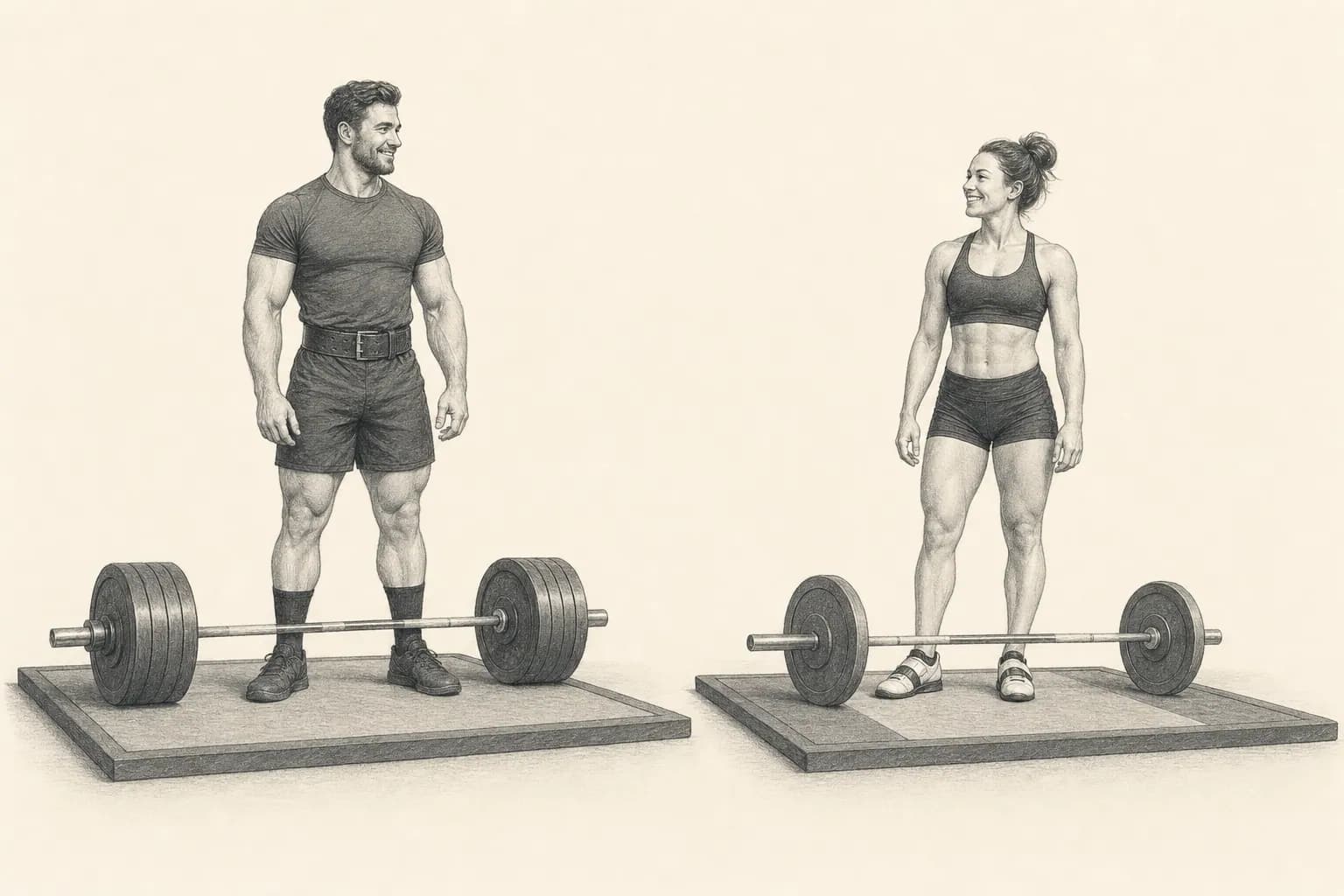
Powerlifting and Olympic weightlifting both put a loaded barbell in your hands, both reward strength and skill, and both crown the lifter with the best total. They differ in the lifts tested, the rules, how fast the bar has to move on a maximal attempt and what makes the technique hard to learn.
Below we compare the lifts, scoring, equipment, technical demand, typical training and access to coaching, then give you five questions to choose with. There is no universal winner, only a better fit.
TL;DR
- Powerlifting tests the squat, bench press and deadlift. Under IPF rules you get three attempts at each, and your total is your best valid squat + bench + deadlift.
- Olympic weightlifting tests the snatch and the clean & jerk. Under the 2026 IWF rules you get a maximum of three attempts at each, and your total is your best successful snatch + best successful clean & jerk.
- Both sports need strength, skill and coaching. A maximal powerlifting attempt can move slowly and still count; the Olympic lifts have to move fast enough for you to get under the bar, so positions and timing carry more of the technical load.
- Powerlifting fits in almost any gym with a rack and bench. Weightlifting usually needs bumper plates, a platform where you can drop the bar, and hands-on coaching while you learn.
- General strength training and bodybuilding are different again: neither is judged on a competition lift.
- Pick by the test you want to be judged on, your gym, your access to a coach, how your positions feel and what else you train for.
What to do this week
- Answer the five questions below and write down your answers.
- Check your gym: is there a squat rack and bench? Are bumper plates and dropping allowed?
- If weightlifting appeals, look for a local weightlifting club or coach before you buy a program.
- If powerlifting appeals, film your squat, bench and deadlift from the side and compare them with our technique priorities for the big three.
- Whatever you choose, train the Workout pillar basics at least two days this week.
Two sports, two different tests
Powerlifting: squat, bench press, deadlift
The International Powerlifting Federation (IPF) Technical Rule Book (version 3, effective 1 March 2026) recognizes four results, always in this order: squat, bench press, deadlift and total. Each lifter gets three attempts per lift, and the best valid attempt on each lift counts toward the total.
Each lift has a standard:
- Squat. After the "Squat" signal, you descend until the top surface of your legs at the hip joint is below the top of your knees, stand up to locked knees, and wait for "Rack".
- Bench press. You lower the bar to your chest after "Start", hold it motionless until the "Press" signal, press to locked elbows and wait for "Rack".
- Deadlift. You pull to a locked-out standing position and hold it until the "Down" signal.
Technique matters in all three lifts, both to meet the standards and to use your strength well. On a near-maximal attempt the bar can slow down a lot and the lift still counts, as long as it meets the standard.
Olympic weightlifting: snatch, clean & jerk
The International Weightlifting Federation (IWF) governs the two Olympic lifts:
- Snatch. The bar goes from the floor to locked arms overhead in one movement, usually caught in a deep overhead squat.
- Clean & jerk. The bar goes from the floor to the front of the shoulders (the clean), then from the shoulders to overhead (the jerk).
Under the IWF's 2026 Technical and Competition Rules & Regulations (TCRR), each lifter gets a maximum of three attempts in each lift, and the total is the best successful snatch plus the best successful clean & jerk. A November 2025 update had already set out that a total requires at least one successful lift of each kind. Bodyweight categories have changed in recent updates, so read the current TCRR before you plan a weight class.
Strength matters a great deal in weightlifting; squats and pulls are staples of its training. But the bar must travel fast enough for you to pull yourself under it and receive it in a deep position, so mobility, timing and technical consistency matter as much as raw strength.
Where general strength training and bodybuilding fit
Neither sport is the same as "lifting weights".
- General strength training uses barbell and other lifts as tools for health, sport or life. There are no referees, no required depth and no meet. The WHO recommends muscle-strengthening activity for all major muscle groups on two or more days a week for adults, and you can meet that without ever competing.
- Bodybuilding is judged on physique: muscle size, shape and conditioning. Nobody scores the weight on the bar.
Side-by-side comparison
| Factor | Powerlifting (IPF) | Olympic weightlifting (IWF) |
|---|---|---|
| Competition lifts | Squat, bench press, deadlift | Snatch, clean & jerk |
| Attempts | Three per lift | Maximum of three per lift |
| Total | Best valid squat + bench + deadlift | Best successful snatch + best successful clean & jerk |
| Bar speed on a maximal attempt | Can be slow; a grinding lift still counts | Must be fast enough to get under the bar |
| Common early hurdles | Meeting the standards (depth, pause, lockout), bracing, building strength | Positions, mobility, timing and confidence under the bar, plus strength |
| Gym equipment | Rack, flat bench, barbell, plates | Bumper plates, a platform where dropping is allowed, a barbell suited to the lifts |
| Personal equipment | IPF Classic: singlet required; approved belt, wrist wraps and knee sleeves allowed. Equipped adds supportive suits, shirts and knee wraps | Lifting shoes and a belt are common; check the current rules |
| Typical practice | Heavy sets of the three lifts plus accessories | Many low-rep sets of the lifts and their variations, plus squats and pulls |
| Learning curve | Coaching helps; slow lifts are easier to review on video between sessions | In-person coaching strongly advised while learning; video is a supplement, not a substitute |
| Access to facilities | Most commercial gyms | Fewer gyms; often a dedicated club |
The equipment and learning-curve rows are coaching guidance, not rules. Your gym and your coach may differ.
How scoring works, with numbers
Here are two hypothetical lifters at a local meet.
Powerlifter, 83 kg class (IPF Classic).
| Lift | Attempt 1 | Attempt 2 | Attempt 3 | Best valid |
|---|---|---|---|---|
| Squat | 170 kg ✓ | 180 kg ✓ | 187.5 kg ✗ | 180 kg |
| Bench | 115 kg ✓ | 120 kg ✓ | 125 kg ✗ | 120 kg |
| Deadlift | 200 kg ✓ | 210 kg ✓ | 220 kg ✗ | 210 kg |
Total: 180 + 120 + 210 = 510 kg (about 1,124 lb).
Weightlifter (hypothetical). Best snatch 90 kg, best clean & jerk 115 kg. Total: 205 kg (about 452 lb).
Totals are not comparable across sports. In both, though, missed lifts can wipe out your result: three failed attempts on one powerlifting lift, or no successful snatch or no successful clean & jerk, means no total.
That is also why attempt selection matters more than beginners expect. A first attempt you can make on a bad day keeps you in the meet.
Technical demand and learning curve
Powerlifting
Each lift has its own technique, and much of the competition-specific skill is meeting the standards: hitting depth, pausing the bench, waiting for commands. Common beginner faults (squats above parallel, bounced benches, deadlifts that lose position) are visible on video, which makes progress between coaching sessions easier to check. A coach still speeds things up, especially before a first meet.
Weightlifting
Mobility in the ankles, hips, upper back and shoulders matters, and so does confidence under a moving bar; small timing errors change the result. Strength is necessary but not sufficient: a strong deadlift does not by itself produce a good snatch. Rep-based 1RM estimates also fit these lifts poorly, because a missed snatch is usually a speed or position problem rather than a slow grind. Our 1RM calculator says not to use it for them.
Coaching guidance: if you are new to the Olympic lifts, get in-person coaching while you learn. Video and online feedback are useful supplements, but they are not a substitute for a coach who can see you lift, and bad habits are harder to remove later.
What training typically looks like
These are typical patterns, not rules. Your program and coach set the details.
Powerlifting training usually means practicing the squat, bench and deadlift several times a week, with heavier sets in the 1–6 rep range, some lighter volume work, and accessories for the muscles that limit your lifts. Beginners often run a simple linear progression first, then move to weekly or block programs. Strength gains from training generally favor heavier loads, according to meta-analyses that compared high- and low-load training.
Weightlifting training usually means many sets of low reps (singles, doubles and triples) on the snatch, clean, jerk and their variations, such as hang or power versions, plus front and back squats and pulls. Sessions are often more frequent.
As one published example, Greg Everett's Starter Program for Catalyst Athletics Online Workouts is a four-week lead-in to Catalyst's regular online programming for lifters who have not been doing the Olympic lifts frequently. It runs four days a week for two weeks, then five, uses the snatch, clean & jerk or their variations plus pulls and squats, lowers the reps and adds heavy singles in weeks three and four, and has lifters choose weights by feel. It assumes you can already perform the lifts; it is not a course that teaches them from scratch.
Equipment, facilities and coaching access
This is the row that decides it for many people. Powerlifting needs a rack or stands, a flat bench, a barbell and plates, which most commercial gyms have. Weightlifting also needs:
- Bumper plates and a platform where you are allowed to drop the bar from overhead.
- A barbell that tolerates being dropped and spins freely enough for fast lifts.
- Room to bail out of a missed lift.
- A coach who can watch you lift live, at least while you learn.
Many commercial gyms do not allow dropping from overhead. Before you commit, ask your gym directly, or search for a weightlifting club nearby.
Which fits you? Five questions
Answer each one honestly. Count which sport comes up more often, but read the explanations: one answer can outweigh the rest.
1. Which test do you want to be judged on?
- The heaviest squat, bench and deadlift I can make to strict standards. Points to powerlifting.
- Getting a bar from the floor to overhead with speed, precision and timing. Points to weightlifting.
- Neither. I want to be strong and healthy. Points to general strength training; you do not need a sport.
- How my physique looks. Points to bodybuilding-style training, even if you lift heavy along the way.
2. What does your gym allow?
- Rack and bench, no dropping. Powerlifting fits now. Weightlifting would need a different gym or club.
- Bumper plates and a lifting platform. Both are possible.
- Home gym. Powerlifting is simpler to equip. Weightlifting needs bumpers, a platform and space.
3. Can you get regular in-person coaching?
- Yes. Either sport works, and weightlifting becomes far more realistic.
- Only online or occasional sessions. Powerlifting is easier to progress this way, because its lifts are easier to review on video between sessions.
- No coaching at all. Start with general strength training or powerlifting, and find a coach before you take up the Olympic lifts.
4. How do the key positions feel?
- A deep squat with the bar overhead or in the front rack feels workable. Weightlifting is accessible to you.
- Overhead and front-rack positions are restricted or painful. Powerlifting may suit you better for now. Persistent pain is a reason to see a qualified clinician, not to push through.
- Not sure. A coach can assess this in one session.
5. What else are you training for?
- A field or mat sport. Both can help, and power cleans often appear in team-sport strength work; see our power cleans for football guide and the sports hub.
- Long-term health and limited time. General strength training or a simple powerlifting-style plan is usually easier to sustain.
- I want to compete soon. Powerlifting usually offers the quicker path to a first meet, because its competition lifts are usually quicker to learn to a legal standard. That is a coaching observation, not a rule.
Still split? You do not have to decide today. Many lifters run a simple barbell program for a few months first. Starting Strength, Mark Rippetoe's novice barbell program, includes the power clean alongside the squat, press, bench press and deadlift, which gives you a taste of a fast pull from the floor. See our Starting Strength guide, then decide.
Common mistakes when choosing
- Choosing by social media. The sport that looks exciting may not fit your gym, schedule or joints.
- Treating gym lifts as meet lifts. A high squat or a touch-and-go bench does not count under IPF rules. Expect gym numbers to drop when you lift to standard.
- Loading the Olympic lifts before positions are consistent. Build positions with light loads and a coach first.
- Ignoring pain. If a competition lift aggravates a current injury, get medical advice before you commit to that sport.
Pillars Check
Workout. Whichever sport you choose, train its competition lifts often and to the standard you will be judged on. Powerlifters should squat to depth and pause the bench in training. Weightlifters should spend most of their early training on positions and speed with light loads. Our Workout pillar covers the basics of progression.
Diet. Both sports reward eating enough to recover and build muscle. The ISSN position stand suggests 1.4–2.0 g/kg of protein per day is sufficient for most people who exercise. In a meta-analysis, the average added benefit of protein for fat-free mass leveled off at around 1.6 g/kg/day; that is a group-level estimate, not a fixed ceiling for every individual. Both sports also use weight classes. Do not make rapid weight cuts or dehydrate to make weight; choose a class you can make while eating normally. See the Diet pillar.
Recovery. Training quality in either sport drops when you are short on sleep. Adults should regularly get seven or more hours per night, per the AASM and Sleep Research Society consensus. Fatigue often shows up first as sloppier technique, so plan lighter days and stop sessions when positions fall apart. See the Recovery pillar.
FAQ
Is powerlifting the same as weightlifting?
No. Powerlifting tests the squat, bench press and deadlift. Olympic weightlifting tests the snatch and the clean & jerk. They have different federations, rules and training.
Which sport is better for building general strength?
Neither is required. General strength training builds strength without competing. Powerlifting-style training targets the squat, bench and deadlift directly; weightlifting training builds strength too, with more emphasis on fast, technical lifts.
Can I learn the Olympic lifts without a coach?
We do not recommend it. The lifts happen fast, faults are hard to judge on video, and bad habits are hard to undo. Video and online feedback can supplement in-person coaching, not replace it. If you cannot get coaching yet, start with general strength training and look for a club.
How do I compare my lifts with other lifters?
Use a tool that says exactly who you are compared with. Our strength standards tool compares raw, drug-tested-category powerlifting results by class and age band, and explains its limits.
Can I do both sports?
Yes, but not at full effort in both at once. Many lifters start in one sport and move to the other, or use one as supplementary training for the other.
Sources
- International Powerlifting Federation. IPF Technical Rule Book, effective 01 March 2026, version 3 (rules page). Supports the lift order, three attempts, total, lift standards, referee signals, and Classic vs Equipped personal equipment.
- International Weightlifting Federation. IWF Technical and Competition Rules & Regulations, 2026. Supports the maximum of three attempts per lift (section 2.1) and the total as best successful snatch plus best successful clean & jerk.
- International Weightlifting Federation. Updated IWF TCRR is now available, 5 November 2025. The prior update; supports that a total requires at least one successful snatch and one successful clean & jerk, and that bodyweight categories changed.
- Everett G. Starter Program for Catalyst Athletics Online Workouts, Catalyst Athletics, 2012. Supports the example introductory weightlifting structure.
- Starting Strength. Starting Strength Training Programs. Supports the novice program's inclusion of the power clean.
- Bull FC, et al. World Health Organization 2020 guidelines on physical activity and sedentary behaviour. Br J Sports Med. 2020;54(24):1451–1462. doi:10.1136/bjsports-2020-102955. Supports muscle-strengthening on two or more days a week.
- Schoenfeld BJ, Grgic J, Ogborn D, Krieger JW. Strength and hypertrophy adaptations between low- vs. high-load resistance training. J Strength Cond Res. 2017;31(12):3508–3523. doi:10.1519/JSC.0000000000002200. Supports greater strength gains with heavier loads.
- Jäger R, et al. International Society of Sports Nutrition position stand: protein and exercise. J Int Soc Sports Nutr. 2017;14:20. doi:10.1186/s12970-017-0177-8. Supports 1.4–2.0 g/kg/day of protein for most exercising people.
- Morton RW, et al. A systematic review, meta-analysis and meta-regression of the effect of protein supplementation on resistance training-induced gains in muscle mass and strength in healthy adults. Br J Sports Med. 2018;52(6):376–384. doi:10.1136/bjsports-2017-097608. Supports a group-level plateau in added fat-free-mass benefit at around 1.6 g/kg/day.
- Watson NF, et al. Recommended amount of sleep for a healthy adult. Sleep. 2015;38(6):843–844. doi:10.5665/sleep.4716. Supports seven or more hours of sleep for adults.