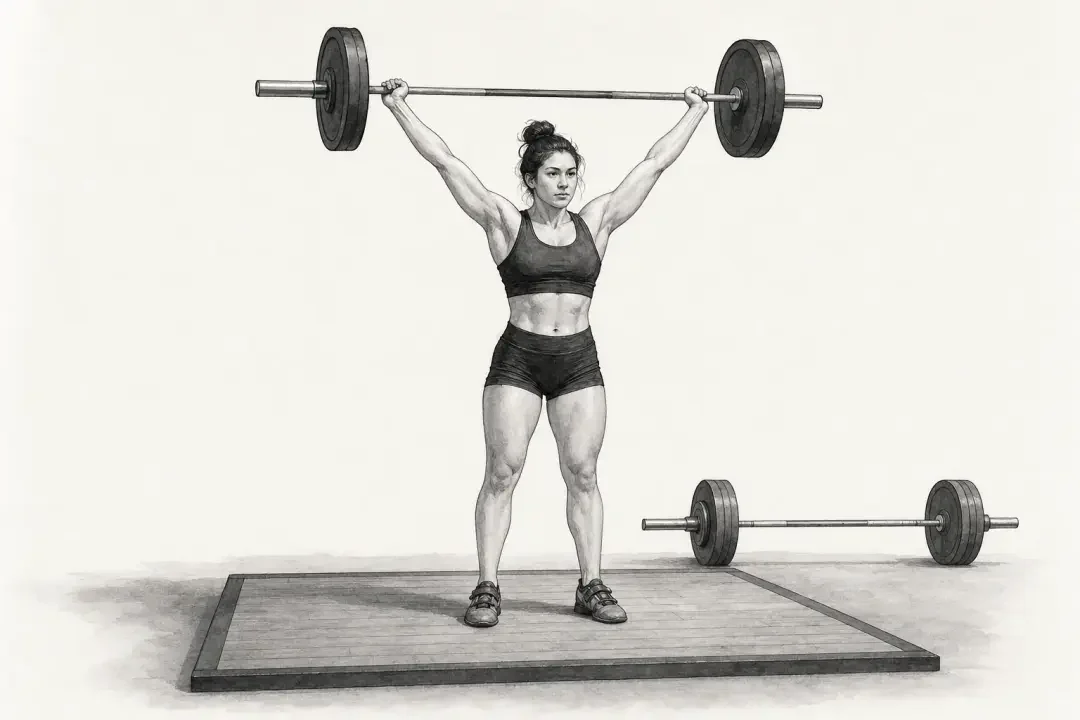
Olympic weightlifting is its own sport, not a harder version of the gym lifts. It has two competition lifts, the snatch and the clean & jerk, and both reward position, timing and consistency as much as raw strength.
So you don't start with a percentage chart. You learn the movements with a qualified coach, then let technical competence decide when the bar gets heavier. This guide covers that path for complete beginners and for strength-trained lifters new to the Olympic lifts.
TL;DR
- Weightlifting has two lifts. Under the IWF's 2026 Technical and Competition Rules & Regulations, each lifter gets up to three attempts at each lift, and the total is the best successful snatch plus the best successful clean & jerk.
- Learn the lifts from a qualified coach in person. Video helps, but on its own it isn't enough to learn these movements.
- You need room to drop the bar, bumper plates and ideally a platform. Many commercial gyms don't allow dropping, so check first.
- Early sessions put technique first, use low reps, and choose loads by how well positions hold, not by percentages.
- Complete novices and strong lifters new to the Olympic lifts start from different places. Their first priorities differ.
- Most technique teaching rests on coaching experience, not controlled trials. Treat any single method as one approach, not the proven one.
What to do this week
- Find a weightlifting club or a coach with a recognized weightlifting coaching qualification. Your national weightlifting federation is a good place to start.
- Book an introductory session before you load a bar for the snatch or clean & jerk on your own.
- Check your gym for bumper plates, a platform or a drop-friendly area, and ceiling and side clearance.
- Film your sessions so you and your coach can review them together.
- Keep your current strength training, but shift squat and pull volume so you arrive at weightlifting sessions fresh.
What weightlifting is, and isn't
The lifts. In the snatch, you take the bar from the floor to overhead in one movement, usually receiving it in a squat with a wide grip. In the clean & jerk, you take the bar from the floor to your shoulders (the clean), stand up, then drive it overhead (the jerk).
The scoring. The IWF's 2026 rules (section 2.1) give each lifter a maximum of three attempts in each lift. Your total is your best successful snatch plus your best successful clean & jerk. Without at least one successful snatch and one successful clean & jerk, you have no total. Bodyweight categories, weigh-ins and national rules change over time, so read the current documents from the IWF and your national federation rather than relying on older summaries.
What it isn't. Weightlifting isn't powerlifting, which tests the squat, bench press and deadlift. It isn't the same as using power cleans in a general strength program either. Starting Strength, for example, includes the power clean, but that doesn't make it a weightlifting program. If you're still choosing a sport, read powerlifting vs weightlifting first.
You should know
Most of what you'll read about teaching the Olympic lifts, including teaching order, positions and drills, comes from coaching experience, not controlled trials. The research we rely on elsewhere for 1RM formulas and effort scales was done mostly on lifts like the bench press, squat, deadlift and leg press, not the snatch or clean & jerk. We label coaching consensus as coaching consensus throughout this guide.
Why qualified instruction matters
The snatch and clean & jerk involve a long bar path, a change of direction under the bar, and receiving a load overhead or in a deep squat. Small errors in the pull show up later as a bar that's out of position, and they're hard to feel from the inside.
A qualified coach:
- Teaches the positions in an order that suits you, and picks the drills.
- Decides when the load can go up, based on what they see.
- Catches faults early, before they become habits.
- Teaches you how to miss, including getting out from under a bar you can't hold overhead.
Finding one. Coaching qualifications differ by country. Look for a coach accredited through your national weightlifting federation or an equivalent recognized program, with experience coaching adult beginners. Ask how they teach the lifts, how they decide loads and how often they'll see you lift.
Where video fits. Filming your heavier sets lets you and your coach review positions frame by frame. It's a feedback tool that supports coaching; it doesn't replace it. If no coach is local, remote coaching with regular video review is a fallback, ideally after some in-person sessions to learn the basics.
Space and equipment
| Item | Why it matters | Minimum to start | Nice to have |
|---|---|---|---|
| Bumper plates | The lifts sometimes end with a dropped bar, from overhead or the shoulders | Enough bumpers for light loads | A full set, plus small change plates |
| Platform or drop area | Protects the floor and the bar, and marks your space | A gym area where dropping is allowed | A dedicated lifting platform |
| Barbell | Grip, spin and fit matter for the receiving positions | A bar with rotating sleeves | A weightlifting bar, plus a lighter technique bar for drills |
| Clearance | You need room overhead, and around you to step away from a miss | Clear space on all sides | Space to put the bar down behind or in front of you |
| Shoes | Stability in the receiving positions | Flat, stable training shoes | Weightlifting shoes with a raised, rigid heel, if your coach recommends them |
| Rack | For squats, jerks from the rack and some drills | A squat rack | Jerk blocks or pulling blocks |
Ask your gym before you start. A gym that bans dropping limits what you can practice, including misses.
Positions and learning progressions
Coaches teach the lifts as a chain of positions, then link them. Exact cues, foot positions, grip widths and teaching order vary between coaches and between lifters. What follows is a high-level map, not a prescription.
| Building block | What it develops | Examples coaches commonly use |
|---|---|---|
| Overhead stability | Holding the bar overhead in the snatch receiving position | Overhead squats and presses with light bars |
| Front rack and front squat | The receiving position for the clean | Front squats, front-rack holds |
| Start and pull positions | Bar close to the body, balance over the feet | Pulls and deadlift variations from the floor and blocks |
| Extension and turnover | Finishing the pull, then moving under the bar | Hang and high-hang variations, power variations received higher |
| Jerk drive and footwork | Driving the bar up and receiving it overhead | Jerk dips, push presses, split or power jerk drills |
| Linking the lift | Full lifts from the floor | Classic lifts with light loads, often after work from the hang |
Some coaches teach the lifts top-down, starting from the hang and working toward the floor. Others teach bottom-up or as whole movements. Our sources include no trials comparing these approaches, so follow your coach's system consistently rather than mixing methods from the internet.
A beginner session structure
A common shape for a learning-phase session looks like this. It's coaching practice, not a fixed rule.
| Block | Example content | Notes |
|---|---|---|
| Warm-up | General warm-up, then light position work | Rehearse the day's positions with the empty or technique bar |
| Main lift work | Snatch or clean & jerk drills or variations | Low reps, often singles to triples, many sets. Stop the block when positions break down |
| Second lift | The other lift's drills, or jerk work | Keep quality high; stop if timing slips |
| Strength | Front or back squats, pulls | Moderate sets and reps, progressed like familiar strength work |
| Optional | Presses, core or back work | Short, and never at the expense of the main lifts |
Example learning week (our illustration, not a named program). Loads are chosen by your coach for each set, based on how positions hold.
- Day 1: overhead squat practice, snatch drills from the hang, front squat.
- Day 2: clean drills from the hang, jerk footwork and drive, back squat.
- Day 3: both lifts from the hang or blocks, clean or snatch pulls.
We suggest three sessions a week as a starting point, if your coach agrees. More sessions give you more chances to rehearse positions, but only help if you still arrive fresh.
Two starting points: complete novice vs strength-trained Olympic novice
| Complete novice | Strength-trained Olympic novice | |
|---|---|---|
| Starting point | New to barbell training | Squats, deadlifts and presses competently, and may have done power cleans |
| Usual limiter | Strength, positions and mobility, all at once | Positions, timing, and overhead or front-rack mobility |
| First priority | Learn positions with light bars while building basic strength | Learn the pull and receiving positions, and resist loading by strength |
| Strength work | A larger share of each week | Maintained, with competing fatigue reduced |
| Common mistake | Adding load before positions are consistent | Pulling a snatch like a heavy upright row, or muscling a clean |
| Sign of progress | The same positions at slightly heavier loads | Lifts that look the same at light and moderate loads |
Decision rules, all coaching guidance:
- If you can't hold an empty bar overhead in a deep squat comfortably and with your coach's approval, spend more learning time on overhead positions before you load the snatch.
- If your front rack is painful or your elbows drop, expect your coach to use rack and front squat work, plus variations, before heavy cleans.
- If your squat is strong but your snatch with a light bar is inconsistent, the gap is technical. More strength won't close it.
- If something hurts in a way that changes how you move, stop loading that lift and get assessed by a qualified clinician.
How competitions work, at a high level
Each lifter gets up to three attempts at the snatch and up to three at the clean & jerk, and the total is the best successful result in each (IWF 2026 rules, section 2.1). National federations and clubs run their own events under rules aligned to their federation. Before you enter one, read the meet information and the current rules on weigh-ins, categories and attire, and ask your coach whether you're ready. Our suggested bar: lifts that are consistent at the weights you'd open with.
Progression: technical competence comes first
A percentage plan assumes you know your max and that the lift is stable. A beginner has neither. Your "max" snatch changes as technique improves, sometimes week to week, so percentages of it point at a moving target.
The research behind rep-max formulas also doesn't cover these lifts. Studies of 1RM prediction equations tested the bench press, squat, deadlift, chest press and leg press, and still found meaningful errors. A 2024 meta-regression on reps at given percentages of 1RM found wide between-person differences, and its authors called for more data on exercises beyond those they could model. Don't estimate a snatch or clean & jerk max from a rep calculator.
Effort scales have a similar limit. The reps-in-reserve RPE scale has supporting studies in the squat and bench press. It's useful for your squats and pulls; see our RPE and reps in reserve guide. It hasn't been shown to work the same way for the snatch or clean & jerk in our sources.
Use technical signals instead. These are coaching guidance:
| What you and your coach see | What it likely means | Next step |
|---|---|---|
| The same positions at a new weight, across several reps and sessions | Technique holds at this load | Make a small jump, often 1–2 kg (about 2–4 lb), as your coach directs |
| You make the lifts, but positions change, such as an early arm bend or receiving high | Load is ahead of technique | Hold or reduce the weight and drill the fault |
| Misses share one cause | A technical fault, not a strength limit | Back off and work the specific position |
| Misses with no pattern, and everything feels heavy | Fatigue or a bad day | Cut the session short and review sleep and food |
| Positions are solid, but squats and pulls lag | Strength now limits progress | Add strength work in the program, guided by your coach |
Once you can perform both lifts consistently, an introductory training block is a reasonable next step. Catalyst Athletics' Starter Program, written by Greg Everett in 2012, is one example. It's a four-week introduction to Catalyst's training, aimed at lifters who haven't been doing the Olympic lifts frequently, and it includes heavy singles. It isn't a course for learning the movements from zero; learn those with a coach first.
Common mistakes
- Teaching yourself from clips. Video can show you what a lift looks like, not what you're doing wrong.
- Loading by strength. A big deadlift doesn't mean a big clean.
- Chasing heavy singles in month one. Consistency at light loads comes first.
- Training in a space where you can't drop the bar. You'll avoid the misses you need to learn to handle.
- Letting squats and pulls crowd out lift practice. Strength work supports the lifts; it doesn't replace them.
Who this guide is for, and who it isn't
For: adults who want to learn the snatch and clean & jerk as a sport, and strength-trained lifters adding the Olympic lifts.
Not for: youth athletes, who should be coached in person under their sport's safeguarding rules, or anyone returning from injury without clearance from a clinician.
Pillars Check
Workout
- Prioritize lift practice when you're fresh, then strength work.
- Keep general strength training in your week. A program like Starting Strength builds a base, but it isn't weightlifting technique practice. See the Workout pillar.
Diet
- Eat enough to recover from frequent sessions. The ISSN position stand suggests 1.4–2.0 g of protein per kg of body weight per day for most exercising people.
- Eat at a sensible time before sessions so you don't train hungry. See the Diet pillar.
Recovery
- Plan your most technical sessions for when you're rested. Aim for at least 7 hours of sleep a night, the adult recommendation from US sleep medicine societies.
- Schedule your hardest squat or pull work so it doesn't fall right before a technique session. See the Recovery pillar.
FAQ
How long does it take to learn the snatch and clean & jerk?
There's no reliable timeline. It depends on how often you're coached, your mobility and strength, and your consistency. Judge progress by whether your positions repeat at light and moderate loads, not by the calendar.
Can I learn Olympic weightlifting from videos?
Not reliably. Videos show what good lifts look like, but they can't tell you what you're doing wrong or when to add weight. Learn with a qualified coach in person. If none is local, use remote coaching with regular video review as a fallback.
Do I need weightlifting shoes to start?
Not always on day one. Flat, stable shoes are fine for early position work. Many lifters later use weightlifting shoes with a raised, rigid heel; ask your coach when.
Should I get strong with a powerlifting-style program first?
It isn't required. Beginners can build strength and learn the lifts at the same time. If you're already running a strength program, your coach can fit the Olympic lifts in and adjust your squat and pull volume.
Am I too old to start weightlifting?
Many people start as adults. Start with a qualified coach, progress based on technique, and get medical clearance first if you have a health condition that affects exercise.
Can I do the Olympic lifts in a commercial gym?
Sometimes. Check whether you're allowed to drop the bar, whether there are bumper plates, and whether you have enough clearance. Without those, practice is limited and misses get riskier.
Sources
- International Weightlifting Federation. IWF Technical and Competition Rules & Regulations, 2026. Section 2.1: up to three attempts in each lift; total equals best successful snatch plus best successful clean & jerk.
- Greg Everett, Catalyst Athletics. Starter Program for Catalyst Athletics Online Workouts, 2012. Four-week introduction to Catalyst's training, including heavy singles.
- LeSuer DA, et al. The accuracy of prediction equations for estimating 1-RM performance in the bench press, squat, and deadlift. J Strength Cond Res. 1997;11(4):211–213. doi:10.1519/00124278-199711000-00001. Formula errors in non-Olympic lifts.
- Reynolds JM, Gordon TJ, Robergs RA. Prediction of one repetition maximum strength from multiple repetition maximum testing and anthropometry. J Strength Cond Res. 2006;20(3):584–592. doi:10.1519/R-15304.1. Prediction tested on the chest press and leg press.
- Nuzzo JL, et al. Maximal number of repetitions at percentages of the one repetition maximum. Sports Med. 2024;54(2):303–321. doi:10.1007/s40279-023-01937-7. Between-person variation in reps at a given %1RM; more data needed for other exercises.
- Zourdos MC, et al. Novel resistance training-specific rating of perceived exertion scale measuring repetitions in reserve. J Strength Cond Res. 2016;30(1):267–275. doi:10.1519/JSC.0000000000001049. RIR-based RPE in the squat.
- Ormsbee MJ, et al. Efficacy of the repetitions in reserve-based rating of perceived exertion for the bench press in experienced and novice benchers. J Strength Cond Res. 2019;33(2):337–345. doi:10.1519/JSC.0000000000001901. RIR-based RPE in the bench press.
- Jäger R, et al. International Society of Sports Nutrition position stand: protein and exercise. J Int Soc Sports Nutr. 2017;14:20. doi:10.1186/s12970-017-0177-8. 1.4–2.0 g/kg/day for most exercising people.
- Watson NF, et al. Recommended amount of sleep for a healthy adult. Sleep. 2015;38(6):843–844. doi:10.5665/sleep.4716. Seven or more hours a night for adults.