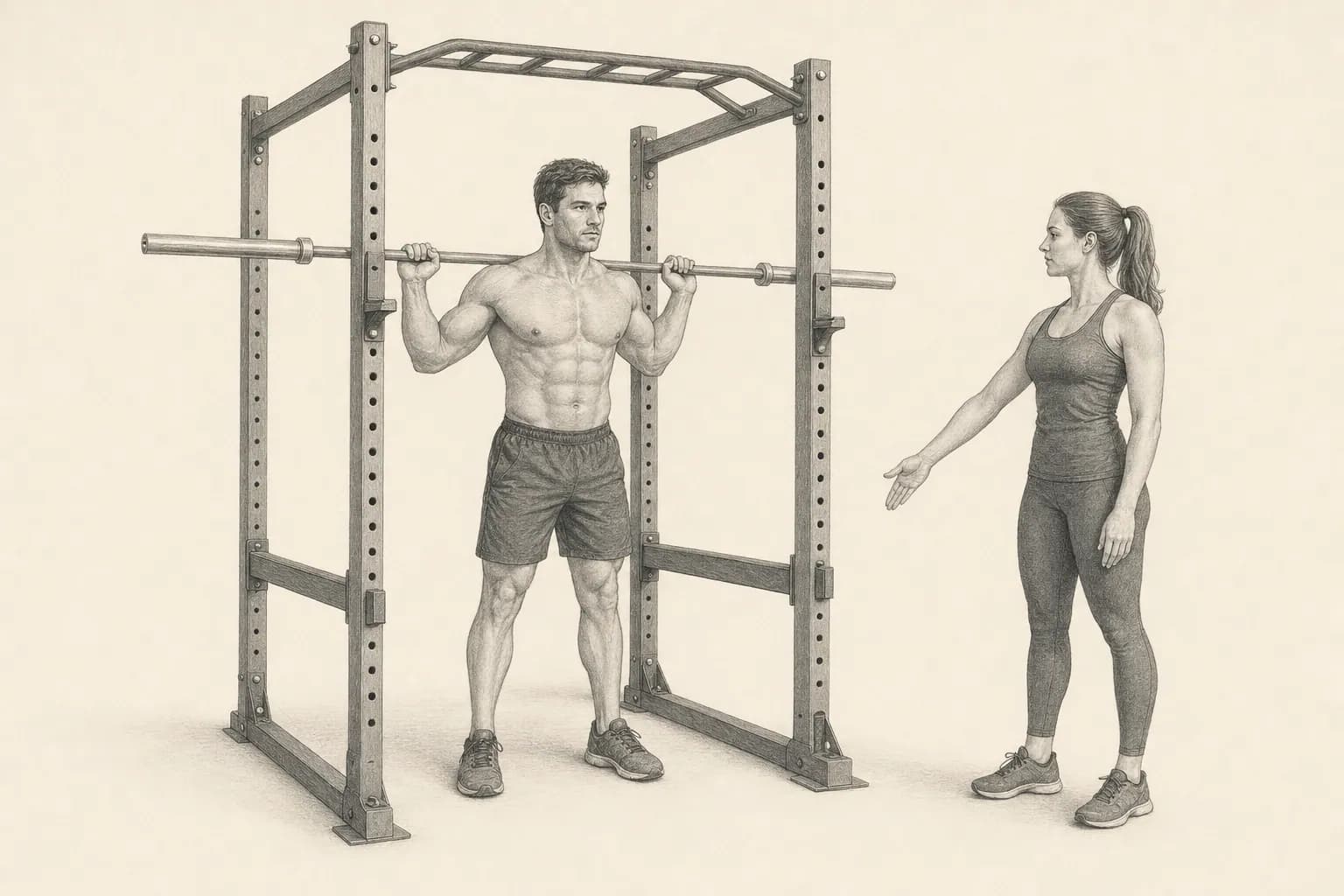
In the gym, you decide when a rep starts and ends. On the platform, the chief referee decides. Lifters who are strong enough for their attempts still get red lights for moving before a command, racking early or dropping a deadlift at the top.
The fix is cheap: learn the sequence, then rehearse it until waiting feels normal. This guide covers the commands in the current IPF rules, what referees judge at a high level, and a rehearsal plan you can run with a training partner.
TL;DR
- This guide follows the IPF Technical Rule Book, version 3, effective 1 March 2026. Other federations may differ, so always read your own federation's current rulebook.
- Squat: walk out, stand still, wait for "Squat." Stand up and wait for "Rack."
- Bench press: lock your arms and wait for "Start." Pause the bar on your chest until "Press." Lock out and wait for "Rack."
- Deadlift: no start command. Lock out, stand still and wait for "Down."
- Moving before a command is a common, avoidable red light. Rehearse commands on heavy sets for weeks before a meet.
- No video, app or article can certify your lift. Only the referees on the day can.
What to do this week
- Download your federation's current rulebook and note the version and effective date.
- On your next heavy squat, bench and deadlift day, have a partner call the commands on every work set.
- Film one set per lift from the side and one from the front, then score it with the checklists below.
- Pause every bench rep until you hear "Press," even on lighter days.
Which rulebook this guide uses
Everything below summarizes the International Powerlifting Federation's Technical Rule Book (version 3, effective 1 March 2026). The IPF publishes the official text in English, and the English version prevails over translations.
This page paraphrases the rules for beginners. It doesn't reproduce them, and it doesn't cover every case. Before a meet, read the full rulebook your federation uses. If you don't compete in an IPF affiliate, your commands and standards may differ.
The three command sequences at a glance
| Lift | Before the lift | During the lift | To finish | If the lift fails |
|---|---|---|---|---|
| Squat | "Squat," with a downward arm movement, once you are motionless and upright | No command | "Rack," with a backward arm movement | "Rack" |
| Bench press | "Start," with a downward arm movement, once your arms are locked and the bar is still | "Press," once the bar is motionless on your chest or abdomen | "Rack," with a backward arm movement | "Rack" |
| Deadlift | No start signal | No command | "Down," with a downward arm movement, once you are motionless in the finished position | No separate command listed |
One more word to know: "Replace." Under IPF rules, if you aren't in the correct starting position for the squat or bench within five seconds, the chief referee tells you to replace the bar and explains why the signal wasn't given.
Squat: "Squat" and "Rack"
The sequence. Take the bar from the rack, with spotters' help if you want it, and step back. Stand motionless and upright with your knees locked. When the chief referee is satisfied, you'll hear "Squat." Descend, stand back up, and hold still with your knees locked until you hear "Rack." Then walk the bar back into the rack. You can't walk out through the front of the rack after the lift.
What referees judge, in plain language:
- You start and finish on the chief referee's signals.
- You're upright with your knees locked at the start and the finish.
- Depth: the top of your thigh at the hip joint goes below the top of your knee. In practice, that means the hip crease ends up lower than the top of the kneecap.
- One descent only. No double bounce at the bottom and no downward movement on the way up.
- Your feet stay put. Rocking between heel and ball is allowed; stepping isn't. Moving your feet after "Rack" is fine.
- Your elbows and upper arms don't support you on your legs.
- Spotters don't touch you or the bar between the signals to help.
- You don't drop or dump the bar after the lift.
Before the squat and bench press, the side referees keep their arms raised until you are in the correct starting position. If a majority of referees see a fault in your setup, the chief referee won't give the start command, and you can use the time left on your clock to fix it.
Bench press: "Start," "Press" and "Rack"
The sequence. Set up, take the bar or accept a lift-off to arm's length, and wait with your elbows locked. When the bar is still, the chief referee says "Start." Lower the bar to your chest or abdomen and hold it motionless. The chief referee then says "Press." Press to straight arms with your elbows locked and hold still until "Rack." In the IPF rules, "Press" is an audible command.
What referees judge, in plain language:
- Your head, shoulders and buttocks stay in contact with the bench for the whole lift.
- Your feet stay flat on the floor. They may move, but they must stay flat, and they can't touch the bench or its supports.
- You use a thumb-around grip, no reverse grip, with your index fingers within the 81 cm marks.
- Your arms are locked before "Start."
- The bar comes down to your chest or abdomen, not your belt, and the underside of both elbows drops to at least the level of the top of your shoulder joints.
- You hold it still until "Press." No heaving or sinking the bar into your chest after it's motionless, and no upper-body thrust to start the press.
- The whole bar doesn't move downward during the press, and you finish with both elbows locked.
- You don't deliberately touch the bar to the rack uprights during the lift.
The bench pause has no fixed duration. It lasts until the bar is motionless and the chief referee calls "Press." That's why rehearsing variable pauses matters more than counting "one-one-thousand."
Deadlift: "Down"
The sequence. There is no start command. Any deliberate attempt to raise the bar counts as an attempt. Pull to lockout and stand still. When you're motionless in the finished position, the chief referee says "Down." Lower the bar to the platform with both hands still in control.
What referees judge, in plain language:
- No downward movement of the bar before it reaches the top. A slight settling as your shoulders come back at lockout isn't a fault.
- At the finish, your knees are locked and you stand erect, with your shoulders back. The current rulebook describes the front of the shoulder finishing behind the line of the bar.
- You don't support the bar on your thighs to work it up. The bar edging up your thighs without support isn't a fault, and the rules say doubtful calls go in the lifter's favor.
- Your feet don't step. Moving your feet after "Down" is fine.
- You don't lower the bar before "Down."
- You don't drop the bar or let it go from your palms on the way down.
How decisions are shown
Each of the three referees has a white light for "good lift" and a red light for "no lift." The lights come on together once the bar is back in the rack or on the platform. After a red light, referees show colored cards, or use the light system, to show the reason: red, blue and yellow each stand for a group of faults on that lift. Ask your handler to note the color so you know what to fix.
Gym reps vs competition reps
Most red lights come from gym habits. This table pairs the common ones with the competition standard and a training fix.
| Gym habit | Competition standard (IPF) | Training fix |
|---|---|---|
| Starting the squat as soon as you walk out | Stand still, knees locked, wait for "Squat" | Partner calls "Squat" on every work set |
| Re-racking as you stand up | Hold still at the top until "Rack" | Count a full beat at lockout before the call |
| Touch-and-go bench | Bar motionless on the chest until "Press" | Pause every rep, with a partner varying the delay |
| Lowering right after the lift-off | Arms locked, wait for "Start" | Partner calls "Start" only once the bar is still |
| Heels rising or a foot lifting on the bench | Feet stay flat on the floor; they may move but must stay flat | Set feet before unracking, check them on video |
| Dropping the deadlift at the top | Hold the finish, wait for "Down," lower under control | Partner calls "Down," and you return the bar with both hands |
| Squats just above parallel | Hip crease below the top of the knee | Film from the side at hip height and judge strictly |
For bar path and bracing, see our technique priorities for squat, bench and deadlift. Commands are about competition rules; technique is about moving the bar well. You need both.
Rehearse commands with a training partner
Your partner plays chief referee. Print the cards, or keep them on a phone, and use them on every heavy set for at least four to six weeks before a meet. That window is a coaching rule of thumb, not a requirement.
| Card | Partner calls | Call it when | You practice | Common miss |
|---|---|---|---|---|
| 1. Squat start | "Squat" | You're motionless and upright, with knees locked, after the walkout | Being still before you descend | Descending straight from the walkout |
| 2. Squat finish | "Rack" | You're motionless at the top with knees locked | Holding lockout | Walking the bar in early |
| 3. Bench start | "Start" | Your elbows are locked and the bar is still | Waiting after the lift-off | Lowering the bar immediately |
| 4. Bench pause | "Press" | The bar is motionless on your chest or abdomen | A real pause without sinking | Pressing on the touch |
| 5. Bench finish | "Rack" | Both elbows are locked and the bar is still | Holding lockout | Racking as the elbows lock |
| 6. Deadlift finish | "Down" | Your knees are locked, you're upright and the bar is still | Holding the finish | Dropping the bar or lowering early |
| 7. Setup check | "Replace" | You aren't set within about five seconds | An efficient, repeatable setup | Fidgeting under the bar |
How to run the rehearsal:
- Vary the timing. Your partner should call some commands quickly and others after a longer hold, so you can't anticipate them.
- Use them on warm-ups too in the final weeks. It's free practice, and warm-ups are where habits form. Our warm-up ramp method leaves plenty of sets for it.
- Self-score on video. For each filmed set, tick yes or no against the referee checklists above. One "no" means you would likely have earned a red light.
- Practice missed reps. On a missed squat or bench, the call is "Rack." Rehearse returning the bar with your spotters so a miss doesn't become a scramble.
If you're preparing for a first meet, pair this with our first powerlifting meet checklist for weigh-ins, gear and attempt selection.
Common red-light causes for first-timers
- Squatting high, especially when the opener feels light and the lifter rushes.
- Pressing the bench before "Press."
- Racking or dropping before the finishing command.
- Lifting a foot or heel off the floor on the bench, or losing flat foot contact.
- Hitching a deadlift up the thighs.
- Missing a gear rule, such as forgetting shin-length socks for the deadlift.
A webpage can't certify your lifts
This guide can help you prepare, but it can't tell you whether a specific rep was legal. Referees judge every attempt live, under the rulebook in force on the day, and their decisions can only be reviewed through the federation's own process. Treat our checklists as practice tools, not rulings.
Pillars Check
Workout
- Train to competition standards on heavy days: depth, paused benches and commands on every work set.
- Keep running your program, whether that's GZCLP, Starting Strength or another option from our beginner powerlifting programs guide, and add commands rather than extra volume. See the Workout pillar.
Diet
- Commands don't change what you eat, but meet day does. Practice eating and drinking the way you will on a long competition day during your longer training sessions. See the Diet pillar.
Recovery
- Paused benches and longer holds add a little time under the bar. Keep sleep consistent, with at least 7 hours a night as the adult recommendation from US sleep medicine societies, and see the Recovery pillar.
FAQ
Does every federation use the same commands?
No. This guide covers the IPF Technical Rule Book effective 1 March 2026 (version 3). Other federations may use different commands or none for some lifts. Read your federation's current rulebook before you train for its meets.
What happens if I start before the command?
Under IPF rules, failing to observe the chief referee's signals is a listed cause for a no lift on the squat and bench. On the deadlift, lowering the bar before the signal is.
How long is the bench press pause?
There's no fixed time. The bar has to be motionless on your chest or abdomen, and then the chief referee calls "Press." Practice with a partner who varies the delay.
Can I move my feet after the squat or deadlift?
In the IPF rules, foot movement after the "Rack" signal on the squat, or after "Down" on the deadlift, is not a cause for failure. Before those commands, stepping is a fault.
What if the referee never gives me the start command?
The referees may see a fault in your setup. Under IPF rules, you can fix it within your remaining time. If you aren't in position within five seconds, you'll be asked to replace the bar and told why.
Can I practice commands without a partner?
Partly. A recording of the calls with random delays helps you learn to wait. A partner is better, because they can judge stillness and depth before calling.
Sources
- International Powerlifting Federation. IPF Technical Rule Book, effective 1 March 2026, version 3. Commands and signals (sections 4 and 7), causes for disqualification of each lift, "Replace" after five seconds, lights and failure cards, English text prevails.
- International Powerlifting Federation. Technical rules page. Where the current rulebook is published.
- Watson NF, et al. Recommended amount of sleep for a healthy adult. Sleep. 2015;38(6):843–844. doi:10.5665/sleep.4716. Seven or more hours a night for adults.