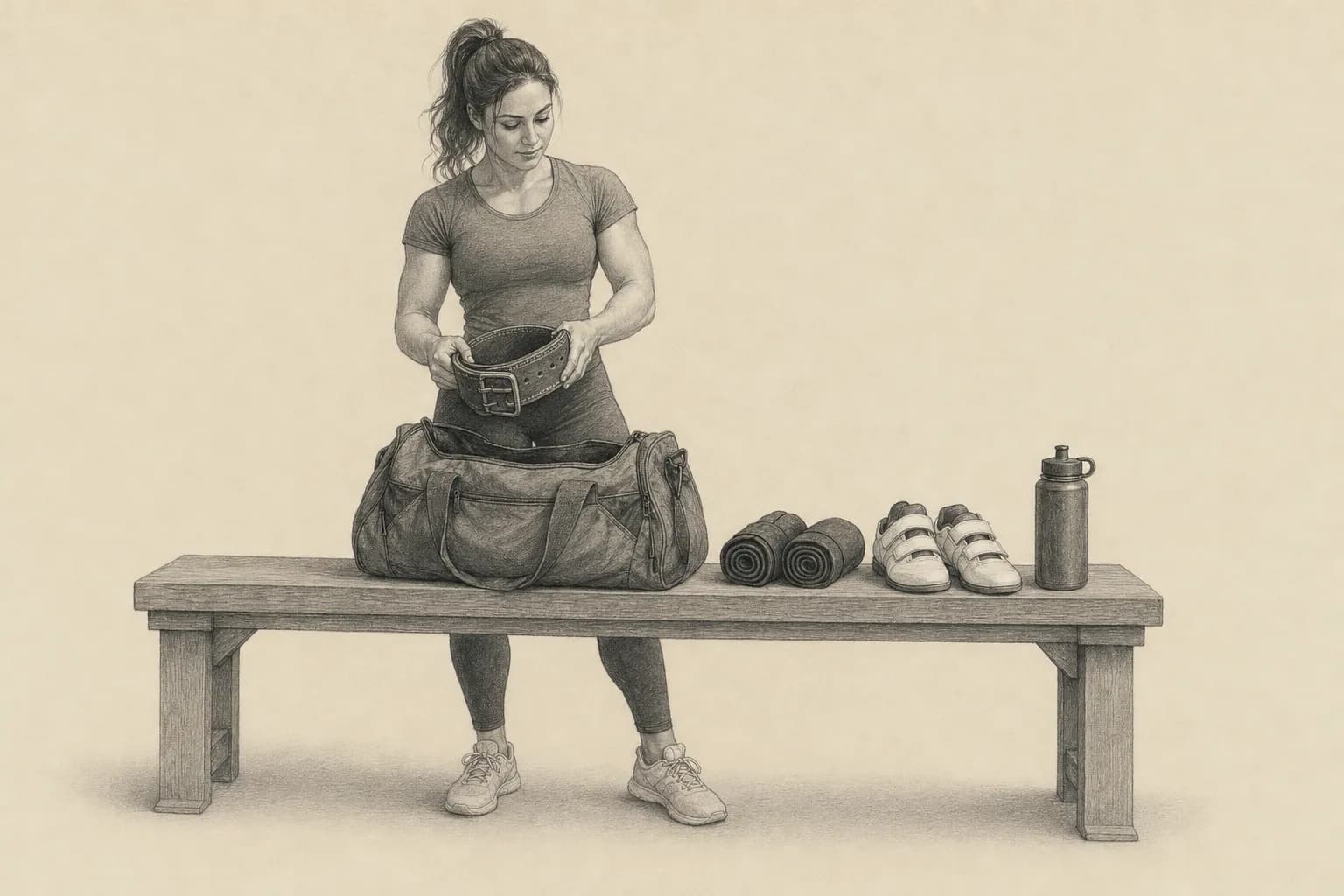
Your first meet is not a test of how strong you are. It is a test of whether you can make nine legal attempts under someone else's rules, on someone else's clock, after a morning of waiting around.
Most first-meet mistakes are logistics, not strength: the wrong socks, a missed command, an opener picked from a good day. This checklist helps you avoid them.
TL;DR
- Pick a federation and division first. Rules, gear lists, commands and drug testing all follow from that choice.
- Read the meet notice and your federation's current rulebook like a contract. Write down deadlines, weigh-in times and equipment rules.
- Choose an opener you could make on a bad day. Decide second and third attempts on the day, ideally with a coach or experienced handler.
- Plan warm-ups by counting attempts, not minutes alone.
- Compete in the weight class you are already in. This guide gives no weight-cutting advice.
- Pack from a written list and review the meet while it's fresh.
What to do this week
- Choose a meet 8–16 weeks out and save the meet notice.
- Download your federation's current rulebook. Note the version and effective date.
- Check whether you need a membership card to enter, and buy it before the entry deadline.
- Compare your belt, sleeves, wraps, singlet and shoes against the federation's current approved list.
- Start practicing commands on your heavy sets. A training partner can call them.
Choose a federation and division
Federations write their own rules. This guide uses the International Powerlifting Federation's Technical Rule Book (version 3, effective 1 March 2026) for concrete examples, labeled as IPF. If you compete elsewhere, your federation's rulebook wins.
| Decision | Your options | What to check |
|---|---|---|
| Federation | An IPF affiliate or another federation | Which meets are near you, membership cost, rulebook version |
| Tested or untested | Drug-tested federations or divisions, or untested ones | The anti-doping policy. If you take prescribed medication, check the rules before you enter |
| Equipment division | Classic/raw or equipped | Most first-timers choose classic/raw. Equipped lifting uses supportive suits and shirts |
| Age division | Open, junior, masters and others | The age bands and how your birth year places you |
| Weight class | The class your current body weight falls in | The class limits and when you must nominate a class |
At IPF-level competitions, a lifter can only weigh in for the category nominated 21 days before the meet. Local meets set their own deadlines, so read the meet notice.
Read the meet notice like a checklist
A meet notice tells you what this meet requires on top of the rulebook. Copy the answers into the blanks before you register.
| Item | Write it here |
|---|---|
| Federation and rulebook version | ______________________ |
| Entry deadline and fee | ______________________ |
| Membership required? Deadline? | ______________________ |
| Divisions offered (tested, classic/raw, age) | ______________________ |
| Weigh-in date, time window and location | ______________________ |
| Session and group (flight) for your class | ______________________ |
| Equipment check time | ______________________ |
| Rack height check time | ______________________ |
| Drug testing policy | ______________________ |
| Bar and plate units (kg or lb) | ______________________ |
| Refund or withdrawal policy | ______________________ |
Equipment checks
Check your federation's current approved list before you buy or pack anything. Approved lists change, and "it's legal at my gym" means nothing on the platform.
IPF examples from the current rulebook, for classic/raw lifting:
- Singlet. A non-supportive singlet is required in classic/raw competition, worn with the straps over your shoulders.
- T-shirt. It must be worn under the singlet in all three lifts.
- Socks. Shin-length socks are required for the deadlift.
- Shoes. Indoor sports shoes or boots, fastened while you lift. No adhesive on the soles.
- Knee sleeves. Approved manufacturers only, at most 7 mm thick and 30 cm long, and never combined with knee wraps.
- Wrist wraps. No longer than 1 m and no wider than 8 cm.
- Belt. Optional, worn over the singlet, with maximum width and thickness limits.
- Powders. Baby powder, resin, talc and chalk (magnesium carbonate) may go on your body and attire, but not on wraps. Oils and lubricants are banned.
IPF referees inspect personal equipment before the session, and inspection closes 30 minutes before your category starts. Wearing an item on the platform that didn't pass inspection can lead to disqualification.
Weigh-ins, groups and the day's timeline
IPF weigh-in rules. Weigh-in starts no earlier than two hours before your session and lasts an hour and a half. Bring photo ID. You are weighed once, unless you're outside your class limits, in which case you can return to the scale within the window. At weigh-in, you or your coach declare your opening weight for all three lifts. Check and sign off your squat and bench rack heights before the session starts. Other federations may use different windows; your meet notice states which.
No weight cutting in this guide
Enter the class your body weight already sits in. This guide gives no advice on rapid weight loss or dehydration for weigh-ins. If you're considering changing your body weight for a future meet, work with a qualified sports dietitian or physician, and plan it well away from meet week.
Groups (flights). Under IPF rules, groups may be formed once 10 or more lifters share a session and must be formed at 15 or more. Lifters with the lowest totals from the previous 12 months lift in the first group, and a lifter with no total goes there automatically.
Rounds and the rising bar. Everyone takes a first squat in round one, a second in round two and a third in round three. The bar only goes up within a round, so the order is lightest attempt first. Lot numbers break ties.
Clocks you must know (IPF):
- You have one minute to start your attempt after you're called to the bar. Miss it and the attempt is forfeited.
- You or your coach have one minute after the lights to submit your next attempt. If you don't, the bar is loaded 2.5 kg heavier after a good lift, or at the same weight after a miss.
- The bar must be a multiple of 2.5 kg, and each attempt must be at least 2.5 kg heavier than the last, except record attempts.
- You can change your first-attempt weight once before a deadline. Second attempts can't be changed, and neither can third squats or benches. A third deadlift can be changed twice.
Between lifts, the IPF allows 20 minutes when the session is a single group, and 10 minutes between disciplines when several groups share the platform.
Attempt selection framework
Your first-meet goal is a total on the board and decisions you can learn from.
| Attempt | Purpose | How to choose it |
|---|---|---|
| Opener | Get on the board and settle nerves | A weight you've lifted to competition standard recently and could make on a bad day |
| Second | Build the total with confidence | Chosen after the opener, based on how fast it moved |
| Third | A personal record, or a total you can bank | Chosen after the second, ideally with a coach |
Rules of thumb you'll hear are coaching conventions, not research findings: open at about 90% of a recent best single or a weight you could lift for about three reps, make the second a weight you've done recently, and base the third on the second's speed. Treat them as starting points, not formulas.
Worked example. A lifter's best competition-standard singles in the last month were a 140 kg squat, 90 kg bench and 170 kg deadlift.
| Lift | Recent best single | Opener | Second | Third if the second was fast | Third if the second was slow |
|---|---|---|---|---|---|
| Squat | 140 kg (309 lb) | 125 kg (276 lb) | 132.5 kg (292 lb) | 142.5 kg (314 lb) | 137.5 kg (303 lb) |
| Bench | 90 kg (198 lb) | 80 kg (176 lb) | 85 kg (187 lb) | 92.5 kg (204 lb) | 87.5 kg (193 lb) |
| Deadlift | 170 kg (375 lb) | 152.5 kg (336 lb) | 162.5 kg (358 lb) | 172.5 kg (380 lb) | 167.5 kg (369 lb) |
The openers total 357.5 kg (788 lb) and the seconds total 380 kg (838 lb). If you miss an attempt, you can repeat the same weight in the next round, but not straight away. Miss all three attempts on any lift and you have no total, which is why the opener matters more than the third.
If you train in pounds, convert your plan to kilos before the meet and check the loading with the plate calculator. In IPF meets, the bar and collars together weigh 25 kg.
If you don't have recent singles, the one-rep max calculator can estimate from a rep set. Use the estimate for openers only, never to pick a third. Studies of rep-based formulas found meaningful errors, including deadlift underestimates by every equation tested, and recommend estimating from ten reps or fewer. Your RPE and reps in reserve notes from training are often a better guide.
Warm-up timing logic
You can't control when you're called, but you can count attempts. Many coaches budget roughly one to two minutes per attempt, including loading. Find your place in the round-one order, count the attempts ahead of you, and work backward.
Example for a 125 kg (276 lb) squat opener. This is an illustration; use the warm-up weights you already use in training.
| Attempts before your opener | Warm-up | Notes |
|---|---|---|
| About 25–30 | Bar × 5, twice | General warm-up done before this |
| About 20 | 60 kg (132 lb) × 5 | |
| About 15 | 80 kg (176 lb) × 3 | |
| About 11 | 100 kg (220 lb) × 2 | |
| About 7 | 112.5 kg (248 lb) × 1 | Put on sleeves and belt |
| About 3–4 | 120 kg (265 lb) × 1, optional | Chalk up, head to the platform area |
| 0 | Opener: 125 kg (276 lb) |
If you're in the second group, the first group's third round is your cue that the clock is running. The pattern is the same as our warm-up ramp method: fewer reps as the weight climbs, and no fatigue before the opener. Warm-up rooms are crowded, so agree on shared bars and plate loading early.
Commands in brief (IPF)
A short summary of the IPF sequence; read your own federation's rulebook for the full standards:
- Squat. Walk the bar out and stand motionless with your knees locked. Wait for "Squat." Descend until the hip crease is below the top of the knee, then stand up. Wait for "Rack."
- Bench press. Lock your arms and wait for "Start." Lower the bar to your chest or abdomen and hold it motionless. Wait for "Press," press to lockout, and hold until "Rack."
- Deadlift. There is no start command. Lift to lockout with your knees locked, standing erect. Wait for "Down," then lower the bar with both hands in control.
A failed squat or bench gets "Rack." If you aren't in the correct starting position within five seconds, the referee says "Replace." Other federations may differ. Practice these in training alongside our technique priorities for squat, bench and deadlift.
Packing checklist (print this)
Fill the blanks from your meet notice and federation rulebook, then tick items off as they go into the bag.
- Photo ID and membership card: number ______________
- Meet notice and rulebook version ______________ saved offline
- Attempt plan in kg: S ______ / ______ / ______, B ______ / ______ / ______, D ______ / ______ / ______
- Singlet that matches the approved list
- T-shirts that meet the rules, plus a spare
- Shin-length socks for the deadlift
- Squat and bench shoes, plus deadlift shoes if different
- Belt (approved or within spec)
- Knee sleeves (approved, no knee wraps if you're in a classic/raw division)
- Wrist wraps within the length limits
- Underwear that meets the rules for weigh-in
- Food and drinks you've already used on training days
- Warm layers for waiting between lifts
- Pen, phone charger and a kg to lb conversion sheet
- Coach or handler: ______________, who knows the one-minute attempt deadline
Post-meet review
Do this within two days, while you still remember how each attempt felt.
| Lift | Attempts (kg) | Lights | Speed (fast, OK, slow) | Red-light reason, if any | Change for next time |
|---|---|---|---|---|---|
| Squat | |||||
| Bench | |||||
| Deadlift |
Then answer four questions:
- Were the openers easy enough? If any opener was a grind, open lighter next time.
- Did any red lights come from commands or standards rather than strength? Those are the cheapest pounds to win back in training.
- Did warm-ups run on time? Adjust your attempt count for next time.
- What does your training need: more practice to standard, more strength, or better recovery?
IPF referees show the reason for a red light with colored cards or the light system, so ask your handler to note it. Results from many federations appear in the OpenPowerlifting database, which is entered by hand and can take a month or more to show a meet. Once your result is there, the strength standards tool shows how totals are distributed in comparable competition cohorts.
After the meet, take a few lighter days before you return to a normal beginner powerlifting program or plan a deload.
Common mistakes
- Opening with a gym PR. A missed opener puts the whole lift at risk.
- Training touch-and-go benches until meet week. Pause your reps for weeks before the meet.
- Skipping the equipment check. An item that didn't pass inspection can cost you an attempt or worse.
Pillars Check
Workout
- Train to competition standards for at least the last 4–8 weeks: depth, paused benches and waiting for commands. That's our rule of thumb, not a rule.
- Keep running your program, such as Starting Strength or GZCLP, and add command practice rather than a new program. See the Workout pillar.
Diet
- Eat normally in meet week and on meet day, using foods you've already trained on. Don't try anything new.
- Drink as you do on training days; see hydration for lifters and the Diet pillar.
Recovery
- Protect sleep in the final week. US sleep medicine societies recommend at least 7 hours a night for adults.
- Reduce training stress before the meet as your coach or program directs, and plan easy days afterward. See the Recovery pillar.
FAQ
How strong do I need to be to compete?
Most first-timers enter local meets. If a meet has a qualifying total, the meet notice will say so. Being new is normal; the platform is where you learn the rules.
What happens if I miss my opener?
Under IPF rules, you can't follow yourself after a miss. You repeat the weight in the next round, and if you miss all three attempts on a lift, you have no total. That's why the opener should be easy.
Do I need a coach or handler at my first meet?
It isn't required, but it helps. Someone has to submit your next attempt within one minute of the lights, track the order and keep your warm-ups on time. A training partner who has read the rules can do it.
Can I use my usual belt and knee sleeves?
Only if they meet your federation's rules. IPF meets require certain items, including knee sleeves, to come from manufacturers on the approved list, so check the current list before meet week.
Should I cut weight for my first meet?
No. Compete in the class you're already in. This guide gives no weight-cutting or dehydration advice; anyone considering it should work with a qualified professional.
What should my last week of training look like?
Lighter and familiar. Keep practicing the competition standards and commands, avoid new maxes, and follow your coach's or program's taper. See how to deload for the principles.
When will my results show up online?
Your federation posts official results. The OpenPowerlifting database enters results by hand, often from PDFs, and new meets can take a month or more to appear.
Sources
- International Powerlifting Federation. IPF Technical Rule Book, effective 1 March 2026, version 3. Weigh-in timing, groups, rounds, attempt clocks and increments, personal equipment rules, referee commands.
- International Powerlifting Federation. Technical rules page. Current rulebook listing.
- OpenPowerlifting. FAQ. Hand-entered results and delays before new meets appear.
- LeSuer DA, et al. The accuracy of prediction equations for estimating 1-RM performance in the bench press, squat, and deadlift. J Strength Cond Res. 1997;11(4):211–213. doi:10.1519/00124278-199711000-00001. Formula errors, including deadlift underestimates.
- Reynolds JM, Gordon TJ, Robergs RA. Prediction of one repetition maximum strength from multiple repetition maximum testing and anthropometry. J Strength Cond Res. 2006;20(3):584–592. doi:10.1519/R-15304.1. Estimate from ten reps or fewer.
- Watson NF, et al. Recommended amount of sleep for a healthy adult. Sleep. 2015;38(6):843–844. doi:10.5665/sleep.4716. Seven or more hours a night for adults.